
4 Key Differences Between Jesus—And Christ
And what it means for those of us who want to follow the former

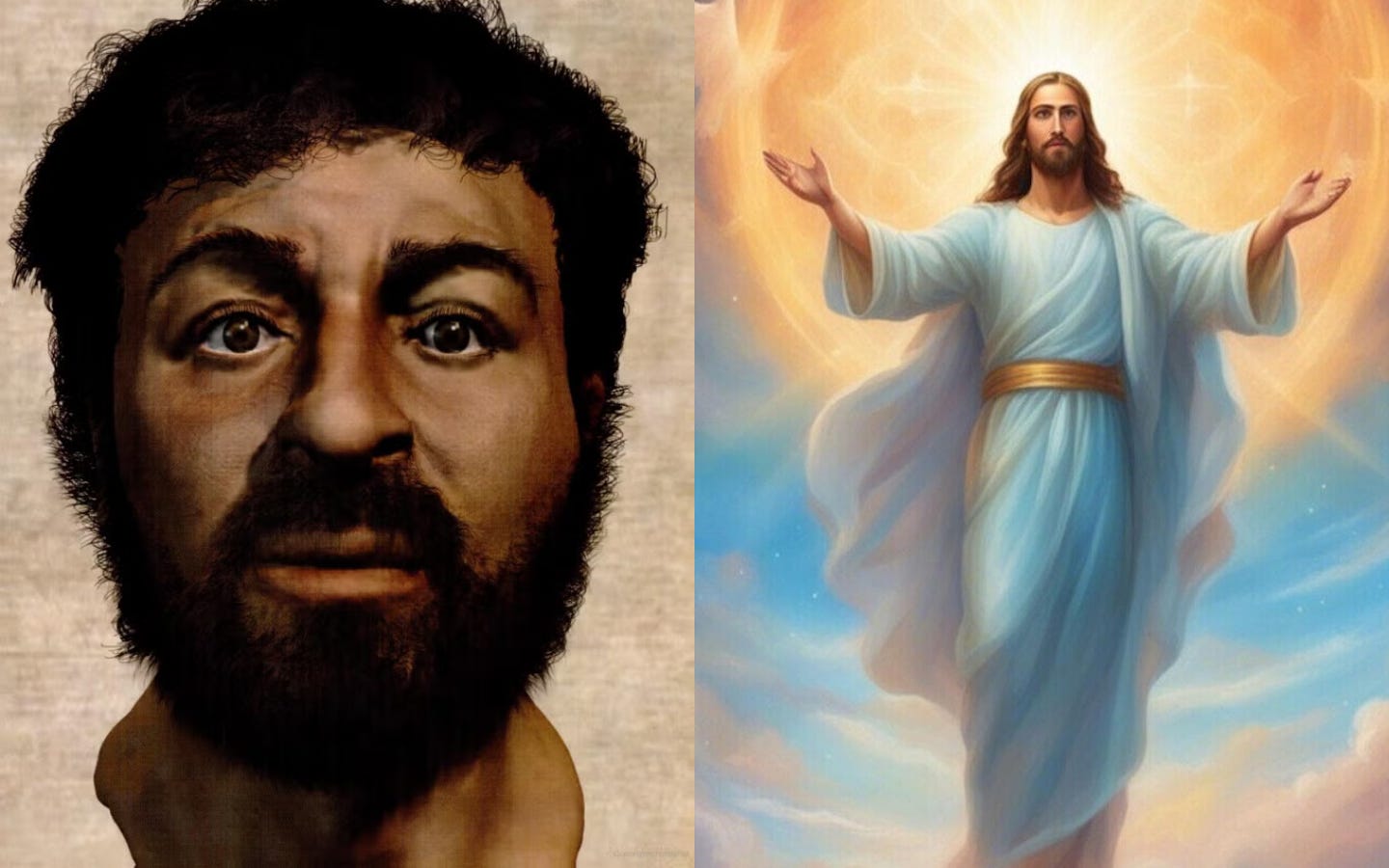
I think I have always loved Jesus.
As a gay kid growing up in the early aughts North Central West Virginia, there seemed something truly radical about the guy.
He hung out with “sinners” (we just called them cool), his best female friend was a prostitute (although we know now that was a lie), and everyone—gay, straight, whatever—was welcome at his table and in his movement.
He seemed to me the exact opposite of who George “God-told-me-to-invade-Iraq” Bush or Jerry “9-11-happened-because-of-gay-people” Falwell would sit with.
Surrounded by Evangelicals, in my senior year of high school I bought a “teen study” Bible. As I read the words of Jesus in three of the four gospels, I wondered, how did they get their religion from the words of this guy?
What I stumbled upon was the difference between Jesus and Christ. They are not the same. One promised a revolution that would turn the world upside down—while the other was invented to make sure that never happens.
1. One Is a Person, One Is an Invention
What’s often lost on most Christians—thanks to two thousand years of propaganda—is that Jesus was a real person who bears little resemblance to the Christ figure that’s based on him.
The actual man Jesus, whom scholars call the historical Jesus, was a Jewish mystic, prophet, and revolutionary who lived and preached along the shores of Galilee in Roman-occupied Palestine some 2,000 years ago.
He eventually took his movement to Jerusalem—the center of Jewish power in the region—where he challenged religious and civil authorities. That was enough to get him noticed and executed by the state, who took any challenge to their colonial authority as a serious threat to be dealt with harshly.
Sadly, nothing survives that Jesus wrote himself—it’s unclear if he could read or write at all (there’s intense debate about this)1—so we have to piece together his life and teachings from things people wrote about him.
What did survive is heavily slanted (that’s not to say it’s inherently bad, all writing has a point of view). The earliest writings we have about the life of Jesus reflect not what he said and did, but represent what they were told he said and did—and what those events meant.
They also record and interpret another event in Jesus’s story that is unverifiable through historical methods: that he came back to life after being executed by the state. We’ll come back to this in a minute.
Nevertheless, by using critical methods and evidence from archaeology, sociology, and political economy, we can build a reliable picture of what the historical Jesus actually preached and did. Scholars—i.e., the people who spend their entire careers on this—have a number of ways of reading the texts to try and decipher what Jesus likely said and did vs. what he likely did not say and do.
The man we can reconstruct through history is Jesus. The character constructed in the decades, centuries, and millennia after his death is Christ.
And to be fair, this does not mean we have a 100% accurate recording of everything in Jesus’s life—far from it. But it does mean we can make very informed decisions on a scale of likely said and probably happened to unlikely not said and probably didn’t happen.
It also does not mean this picture is unchanging. New evidence and new theories are developed all the time, further evolving our picture of the historical Jesus. For example, in 1945, Egyptian farmers digging for fertilizer stumbled upon the Gospel of Thomas, which upended scholarship for decades.2 Who knows what will be discovered next?
2. One Challenged Power, One Accepted It
When we separate what’s likely authentic about Jesus from what’s likely not, a stark picture emerges: these two figures had completely different relationships with power.
Jesus came from the long tradition of Jewish prophetic witness—the tradition of Elijah, who confronted a corrupt king to his face, and Jeremiah, who told the religious establishment exactly what God thought of their Temple.3 These were not quiet men. They were trouble. They were part of a long, sacred Jewish tradition of standing up to inequality and hypocrisy.
Jesus fit that mold. Coming from a working-class background,4 he saw the drastic inequality of the society around him—and how central the religious establishment was in maintaining it. The Temple in Jerusalem wasn’t just a house of worship; it was a financial institution, a tax collection apparatus, and a key part of Rome’s colonial infrastructure. The priests who ran it served at Rome’s pleasure, enriching themselves while sending tribute to Rome.
When Jesus took his movement to Jerusalem, he violently attacked that apparatus. It’s one of the few events in Jesus’s life that appears in all four canonical Gospels, and one of the few things scholars agree most likely happened.5
Historians also think that Jesus’s “stunt” in the Temple—when it was packed with religious pilgrims for Passover—would certainly get him noticed by Roman authorities. Just decades before, around the time of Jesus’s birth, a massive riot broke out in that very place that threatened Roman rule. A Roman legion had to be marched south from Syria to restore order—and two thousand people were crucified once order was restored.6
They did the exact same thing to Jesus. Sensing a threat, the Romans also crucified Jesus. Most Christians don't realize that the word commonly translated as 'thieves' or 'robbers' in that scene is a mistranslation7—crucifixion was reserved for people who threatened Rome or disturbed the social order (like defiant or runaway slaves). It was a political—not theological—punishment.
After his murder, his followers—no dummies—drew the obvious conclusion. For the movement to survive, it had to stop challenging Rome (at least so directly). As such, the texts that emerged in the decades after his death are noticeably more careful.
Paul, writing to communities scattered across the Roman empire, takes pains to frame the movement as politically harmless. Even Revelation—perhaps the most incendiary anti-Roman document in the entire New Testament—goes to elaborate lengths to disguise what it’s actually saying, burying Rome under layers of allegory and code. The beast isn’t named. The city isn’t named. Everyone knew anyway, but the authors knew better than to be explicit about it.8
Christ, as constructed by these early writers, had made his peace with Caesar. Jesus never did.
3. One Preached Revolution, One Preaches Salvation
One of the other things that almost every scholar agrees on is that Jesus’s message centered on a coming Kingdom where God would be in control of everything. This is commonly translated as the “Kingdom of God,” and it appears some 162 times in the New Testament.9
But to Jesus and Christ, they mean vastly different things—and have vastly different requirements for entry.
For Jesus, the Kingdom of God was as political as it was spiritual—and the politics were unmistakable to anyone paying attention. Take the Beatitudes, which appear in two versions in the Gospels.10 Matthew's version, in the Sermon on the Mount—the one most Christians know—reads, "Blessed are the poor in spirit." Luke’s version, in the Sermon on the Plain, reads radically different: "Blessed are the poor." Full stop.
Matthew’s version is spiritual, Luke’s version is material—visceral. Where Matthew has "blessed are those who hunger and thirst for righteousness," Luke has "blessed are you who are hungry now." And then, pointedly, "woe to you who are rich." Matthew's version is a spiritual disposition anyone can claim. Luke's version is a class analysis. Scholars generally agree that Luke’s version is more likely to be authentic. (However, scholars disagree on the woe sayings in Luke that some of us are so fond of.)11
The political charge of this message is so explosive that some scholars have stopped translating βασιλεία—basileia—as "kingdom" altogether, preferring "reign of God" or "commonwealth of God." To a modern U.S. reader, we might call it the “United States of God”—a complete political reorganization with different rulers, different laws, and a radically different distribution of power and resources.
This message was extremely dangerous. It meant that Rome and existing religious authorities were about to lose power. And as we just saw, it got Jesus killed.
Unsurprisingly, the Christ figure that developed after his death took a much softer approach. This is partly why “blessed are the poor” became “blessed are the poor in spirit” are not the only passages to become more spiritual than material in Matthew.
Also, the requirement for entry into the Kingdom shifted. It got much easier. It went from how you treated the poor and the stranger, to what you believed about Jesus himself—specifically, whether you believed he had physically risen from the dead. This claim (flagged earlier) is unverifiable through historical methods; it's precisely that unverifiability that made it so useful.
This shift is most visible in the Gospel of John and in Paul, who developed largely independently of each other but arrived at the same theologically convenient conclusion: that the path to salvation ran through correct belief in the resurrection, not through the dangerous business of reorganizing the social order.
A requirement of belief is infinitely less threatening to the ruling class than a requirement of justice. You can believe whatever you want in the privacy of your own soul. Feeding the hungry and canceling the debts of the poor requires changing the world.
The church spread the belief version—violently, for centuries.
4. One Was Only Human, One is Half Divine
The final difference between Jesus and Christ is perhaps the most consequential—and the most politically useful.
The historical Jesus was a human being. A Jewish peasant from Galilee who ate, slept, got tired, and was executed by the state. Whatever he believed about his own role in the coming Kingdom—and he clearly believed he had one, from announcing it onward—the specifics have been lost to history.
Scholars believe it was highly unlikely that Jesus went around calling himself God or the Son of God (as the Gospel of John claims). Such ludicrous claims would be heard then as they might be heard today—at best sacrilegious, at worst—crazy.
When another “prophet” appeared in Jerusalem about 30 years after Jesus’s execution announcing the coming destruction of the Temple, the Romans whipped him—like Jesus—but then released him as a harmless lunatic.12
But after Jesus’s death, and his followers’ claim that he had risen from the dead, Christ started to become something much more than just a radical preacher, prophet, and mystic. Paul—writing some 15 to 20 years later—describes Jesus in terms that go well beyond a prophet or teacher.
By the time the Gospel of John is written, probably around 90-100 C.E., Jesus is the pre-existing, divine Word of God, present at the creation of the universe. The trajectory moved in one direction only: upward.
In 325 C.E., the Roman Emperor Constantine convened the Council of Nicaea and presided over the vote that made it official. The man from Galilee was declared fully divine—co-equal with God, of the same substance. Thus the man who was murdered for challenging empire became its protector. Jesus had become Christ.
The theological move completed what the political move had started. A divine Christ, floating above history, above the problems of this world, could mean anything to anyone—and has. A Jewish revolutionary calling out the Temple’s collaboration with empire makes demands on our lives that continue to this day. A cosmic savior offering personal salvation is much easier to live with, and much easier to enlist in the service of whoever happens to be in power.
Jesus was dangerous because he was human and specific. Christ became safe because he was divine, abstract, and placating.
What It Means For Us
Honestly, why Rome killed Jesus makes perfect sense. His message was powerful, dangerous, and aimed directly at the people who ran the world. Why Rome co-opted his movement also makes perfect sense—it’s the perfect example of how religion can be weaponized to make the oppressed internalize their own oppression.
But here’s what Rome couldn’t kill, and what every ruling class since has failed to fully bury: the message itself. The historical Jesus—the actual man underneath the theological construction—is still there, still recoverable, still making the same demands he made in first-century Palestine. Blessed are the poor. Woe to the rich. The last shall be first.
That message is as dangerous today as it was when it got him executed. The White House and Wall Street know it, even if they’d never say so out loud—which is why they need Christ, the cosmic savior who asks only for your belief, and want nothing to do with Jesus, the Jewish revolutionary who asks for your entire life.
ONE LAST THING… If you like my work, consider supporting my work financially. I want to keep all my writing on here free—forever—but I can only do that with your help. Thank you for reading! Click here to support me.
Literacy in first-century Roman Palestine was extremely rare outside of scribal and priestly classes—some scholars estimate general literacy rates as low as 3%. The primary evidence that Jesus could read comes from Luke 4:16–20, where he reads from Isaiah in a synagogue. Most historical Jesus scholars treat this scene with skepticism, noting that Luke has a clear theological agenda in placing it at the opening of Jesus's public ministry. For the broader debate, see Bart D. Ehrman, Jesus Before the Gospels (HarperOne, 2016).
The Gospel of Thomas is a collection of 114 sayings attributed to Jesus, with no narrative—no birth, no miracles, no death, no resurrection. It was discovered in 1945 near Nag Hammadi, Egypt, part of a cache of documents buried in a ceramic jar. About half its sayings have parallels in the Synoptic Gospels; the other half are unique. Scholars debate its date—probably written down around 125-140 CE in its final form, though some sayings may be as early as the Synoptics. Unlike the canonical Gospels, Thomas shows signs of later Gnostic theology—salvation through secret knowledge rather than ethics or belief. For a reliable, accessible single-volume introduction to the Gospel of Thomas, see Stevan Davies, The Gospel of Thomas: Annotated and Explained (SkyLight Paths, 2002).
For the Hebrew prophetic tradition as social and political witness, the amazing Robert Alter's beautiful translation and commentary is the place to start. Elijah's confrontation with Ahab is in 1 Kings 21; Jeremiah's Temple sermon in Jeremiah 7 and 26. See Robert Alter, The Hebrew Bible, Volume II: The Prophets (W. W. Norton, 2018). Alter's footnotes are particularly valuable for recovering the political charge of prophetic speech that modern translations tend to flatten.
The Greek word typically translated "carpenter" is tektōn (Mk 6:3; Mt 13:55), which more accurately describes a craftsman or builder working with stone and wood. In the economic structure of Roman-occupied Galilee—where peasants, artisans, and day laborers together constituted the vast majority of the population living at or near subsistence under Roman tribute demands—"working class" is an anachronism but I think a reasonable modern approximation.
The Temple incident appears in all four canonical Gospels: Mt 21:12–13, Mk 11:15–17, Lk 19:45–46, Jn 2:13–16. Its presence across all four—including John, which operates largely independently of the Synoptics—is among the strongest arguments for historicity. The nature and scale of the disruption is debated: some scholars read it as a limited symbolic demonstration, others as a more significant act of physical disruption. John's Gospel uniquely mentions a whip, which most scholars treat skeptically as a later dramatic addition. What is not seriously contested is that something provocative happened in the Temple during Passover, and that Roman authorities took notice. For the historical case, see E.P. Sanders, Jesus and Judaism (Fortress, 1985), which treats the Temple action as the key to understanding Jesus's execution.
Josephus records this episode in The Jewish War, Book II. Around 4 BCE—near the time of Jesus's birth—riots broke out in Jerusalem during the festival season following the death of Herod the Great. Publius Quinctilius Varus, the Roman governor of Syria, marched south with his legions to restore order. Josephus records that approximately two thousand people were crucified in the aftermath. Flavius Josephus, The Jewish War, 2.5.1–2.
The Greek word typically translated "thieves" or "robbers" in the crucifixion scene (Mt 27:38, Mk 15:27) is lēstēs—a term that in first-century Judea carried strong connotations of social banditry or armed resistance to Roman authority, distinct from ordinary theft. The same word is used by Josephus to describe Jewish rebels and insurrectionists. For the political dimensions of lēstēs and crucifixion as Roman state punishment, see John Dominic Crossan, The Historical Jesus: The Life of a Mediterranean Jewish Peasant (HarperOne, 1991).
The identification of "Babylon" in Revelation as Rome and the beast as the Roman Emperor is the mainstream scholarly consensus, not a fringe reading. John of Patmos wrote in deliberate code—"Babylon" was a well-established cipher for Rome in Jewish apocalyptic literature of the period, and the "seven hills" of Revelation 17:9 are an unmistakable reference to Rome's famous geography. For the most accessible treatment of Revelation as anti-Roman wartime literature, see Elaine Pagels, Revelations: Visions, Prophecy, and Politics in the Book of Revelation (Viking, 2012).
This count includes both "Kingdom of God" and "Kingdom of Heaven"—Matthew's Gospel characteristically substitutes "Heaven" for "God," likely out of Jewish reverence for the divine name, but the two phrases refer to the same concept. The kingdom is the single most dominant theme in the teaching of the historical Jesus. See E. P. Sanders, The Historical Figure of Jesus (Penguin, 1993).
Matthew 5:3–12 (Sermon on the Mount) and Luke 6:20–26 (Sermon on the Plain).
Robert Funk, Roy W. Hoover, and the Jesus Seminar, The Five Gospels: What Did Jesus Really Say? (San Francisco: HarperSanFrancisco, 1993), 289-293.
Josephus records this figure as Jesus ben Ananias, a peasant farmer who appeared in Jerusalem around 62 CE—some three decades after the execution of Jesus of Nazareth—crying out doom against the city and Temple. Arrested and brought before the Roman procurator Albinus, he was flogged but released as a lunatic when he refused to stop his prophecies. He continued for seven years until he was killed by a Roman catapult during the siege of Jerusalem in 70 CE. Flavius Josephus, The Jewish War, 6.5.3.
Good article. Modern Christianity has developed something vastly different from what Jesus taught. We may never grasp his message without understanding the Jewishness of Jesus. It should be interpreted within that framework for correct context and interpretation.
Man has taken the “way” of Torah through Jesus and turned it into a system of doctrinal beliefs with which Jesus would not be aligned. It is time to strip back to Jesus’s ethical core for living.
My wife is a devout (Baptist) Christian, and among other things believes the Bible. While I do not think the Bible is completely worthless, knowing what I know about human nature as well as the historical creation of the Bible makes me a skeptic. Aside from the political machinations of 325 AD, all you have to do to understand that skepticism is the game known as "Telephone." Witness testimony in modern jurisprudence is notoriously unreliable. So when I hear that someone living 50-100 years after the crucifixion wrote something that someone told them, I'm skeptical that that is truly "the word of God." Like you, Andrew, I do find the historical Yeshua powerfully attractive, and many of the writings that were excluded from the Bible of considerable interest. I suspect He would find much of modern Christianity cringeworthy. Anyway, I find essays like this food for thought.